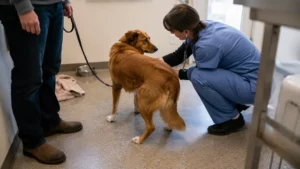
Watching your dog have a seizure can be frightening, but the first steps are relatively simple: stay calm, remove nearby hazards, do not restrain your dog or place anything near their mouth, time the episode, and contact a veterinarian. After the seizure ends, move your dog to a quiet, secure environment and carefully monitor their recovery. Seek emergency veterinary care if the seizure lasts five minutes or longer, happens repeatedly, or your dog does not begin recovering normally.
A seizure may be an isolated event, but it can also be associated with epilepsy, toxin exposure, low blood sugar, liver disease, neurological disorders, or other underlying health problems. Even when a dog appears normal afterward, professional veterinary guidance is important. Knowing what to observe and how to respond can protect your dog while giving the veterinary team useful information for determining what happened.
Stay Calm and Make the Area Safe
During a seizure, your dog cannot consciously control their movements. Stay nearby, but do not attempt to hold them down. Move furniture, sharp objects, children, and other pets away from the area. If your dog is near stairs, water, a fireplace, or another hazard, use cushions or folded blankets to create a protective barrier.
Do not place your fingers, a spoon, or any other object inside your dog’s mouth. Dogs cannot swallow their tongues during a seizure, but involuntary jaw movements can cause a serious bite. Your dog is not trying to hurt you – their muscles are simply operating without consulting the management team.
Avoid moving your dog unless their current location creates an immediate danger. Once the seizure stops, reduce noise, dim bright lights, and give your dog enough space to recover without being surrounded by worried family members.
Time and Record the Seizure
Seizures often feel much longer than they actually are. A one-minute episode can seem like an entire afternoon when you are watching your pet experience it. Check the clock or use your phone to record the exact duration.
If it is safe, record a short video without getting too close to your dog. The movements, body position, sounds, and level of awareness shown in the recording may help a veterinarian distinguish a seizure from fainting, muscle tremors, unusual sleep movements, or another medical episode.
Write down the following information:
- When the seizure started and how long it lasted
- What your dog was doing immediately before it began
- The movements, sounds, or behaviours you observed
- Whether your dog lost consciousness or bladder control
- How your dog behaved after the seizure
- Any possible exposure to medications, chemicals, plants, food, or toxins
This record can become especially useful if another episode occurs. Patterns involving exercise, meals, sleep, medication, stress, or time of day may help your veterinary team investigate the cause.
Expect Temporary Confusion
The recovery period following a seizure is known as the postictal phase. During this time, a dog may appear confused, restless, uncoordinated, unusually hungry, temporarily blind, or extremely tired. Some dogs wander around the house as though someone quietly rearranged all the furniture while they were not looking.
The postictal phase can last from several minutes to several hours. In some cases, changes in behaviour may continue for up to a day. Keep your dog in a secure, comfortable area and block access to stairs, balconies, pools, and other dangerous locations.
Approach slowly and speak in a calm voice. Even a normally gentle dog may react unpredictably when frightened or disoriented. Allow your pet to recognize you before attempting to touch or move them.
Offer Water Carefully
Your dog may be thirsty after recovering, but do not immediately place a large bowl of water in front of a disoriented animal. Wait until your dog is alert, able to stand safely, and swallowing normally.
Begin by offering a small amount of fresh water. Drinking too quickly could lead to coughing, choking, or vomiting. Food can usually wait until your dog is fully responsive and walking normally, unless your veterinarian has given different instructions based on a known medical condition.
Do not give human medications, supplements, sugar, CBD products, or home remedies unless specifically directed by a veterinarian. Something promoted online as “natural” can still be ineffective, interfere with prescribed treatment, or be dangerous for dogs. The internet may have many talents, but conducting a neurological examination is not one of them.
Know When It Is an Emergency
A brief, isolated seizure may stop without immediate medical treatment, but every first seizure should be discussed with a veterinarian. Certain situations require urgent care rather than observation at home.
Contact an emergency veterinary provider immediately when:
- The seizure lasts approximately five minutes or longer
- Your dog has more than one seizure within 24 hours
- Another seizure begins before your dog has fully recovered
- Your dog has difficulty breathing or remains unconscious
- You suspect poisoning, trauma, or medication exposure
- The dog is pregnant, very young, elderly, or has another serious condition
- The seizure occurs in extreme heat or your dog feels dangerously hot
- Recovery appears unusually prolonged or your dog’s condition is worsening
Repeated seizures within a short period are known as cluster seizures. A prolonged seizure or repeated seizures without normal recovery may develop into status epilepticus, a life-threatening condition requiring immediate veterinary treatment. Prolonged muscle activity can raise body temperature and increase the risk of organ or brain damage.
When urgent assessment is needed, contact an emergency vet in Airdrie and explain what happened before leaving home. Calling ahead allows the veterinary team to prepare and gives you an opportunity to receive transportation instructions.
Contact Your Veterinarian After the Episode
Even when your dog appears completely normal afterward, schedule a veterinary examination. A seizure is a symptom rather than a complete diagnosis. The goal is to determine why it happened and whether treatment or monitoring is necessary.
Your veterinarian may ask about your dog’s age, breed, medical history, medications, diet, possible toxin exposure, and behaviour before and after the event. Depending on the situation, diagnostic testing may include bloodwork, urine testing, blood pressure measurement, neurological assessment, diagnostic imaging, or referral for specialized evaluation.
Potential causes can include idiopathic epilepsy, low blood sugar, liver or kidney problems, electrolyte abnormalities, toxins, infections, inflammation, trauma, and structural changes within the brain. The appropriate investigation depends on your dog’s age, physical examination, history, and test results.
The team at Thrive Vet Care can assess your dog, review any videos or notes you collected, and recommend sensible next steps. Visiting an experienced Airdrie veterinary clinic helps ensure that decisions are based on your dog’s individual condition rather than guesswork or a late-night search spiral.
Follow the Treatment Plan Precisely
Not every dog that experiences one seizure requires lifelong medication. Treatment decisions may depend on the suspected cause, frequency, duration, and severity of the episodes.
For dogs that require anticonvulsant medication, consistency is essential. Give every dose at the prescribed time and never suddenly stop the medication unless your veterinarian directs you to do so. Abrupt changes can trigger serious seizure activity.
Some medications require periodic blood tests to monitor drug levels and organ function. Keep follow-up appointments and report changes in appetite, thirst, coordination, energy, behaviour, or seizure frequency. Veterinarians may adjust the dose or combine medications when seizures are not adequately controlled.
Ask your veterinarian whether your dog should have a prescribed rescue medication at home. In selected cases, emergency medication may be provided with specific instructions for use during prolonged or repeated seizures. Never use another pet’s medication or attempt to estimate a dose yourself.
Create a Long-Term Seizure Log
If your dog experiences additional seizures, keep a detailed log. Record the date, time, duration, possible triggers, symptoms, recovery time, and medication schedule. Include videos whenever they can be recorded safely.
A seizure diary helps your veterinarian determine whether the episodes are becoming more frequent, lasting longer, or changing in appearance. It can also reveal whether a treatment plan is working.
Do not rely on memory alone. After several stressful episodes, “I think it happened sometime last month” is not quite the clinical masterpiece your veterinarian needs.
Stay Prepared Without Living in Fear
A seizure can be deeply unsettling, but many dogs with seizure disorders continue to enjoy active, comfortable lives with appropriate veterinary care. Preparation makes future episodes easier to manage.
Keep your veterinary clinic’s contact information readily available, store prescribed medications correctly, maintain an updated seizure log, and make sure everyone in the household understands basic seizure safety.
Most importantly, do not try to diagnose or manage recurring seizures entirely at home. Prompt professional assessment can identify treatable causes, reduce the risk of complications, and create a plan tailored to your dog.
After a seizure, your dog needs calm surroundings, careful monitoring, and qualified veterinary support. You do not need to have every answer immediately – you simply need to take the right next step.